
The short version
- The white hat link building strategies that still earn links in 2026, plus the honest version of the argument against them, taken from SEOs who watch black hat competitors outrank them and say so out loud.
On this page14 sections
- Why white hat link building matters in 2026
- Where the white-hat line actually sits
- Create link-worthy content that attracts natural links
- Write high-quality Guest posts on relevant websites
- Use digital PR to earn high-authority mentions
- Target resource pages and link roundups
- Try broken link building for quick wins
- Avoid these common pitfalls
- The strongest argument against doing this the slow way
- What the same thread says back
- How to actually decide
- Why the slow links keep working
- Where to start this week
- Sources
- FAQs
- Related tools & guides
Link building has held up as one of the most stable digital marketing strategies there is, and some of the best-performing websites in 2026 got there on the back of strong link-building work. The businesses that commit to white hat link building are the ones building SEO that lasts. Black hat link building takes the shortcut: quick wins in exchange for putting the whole site at risk. White hat link building is slower, but it produces a site that holds up.
White hat link building means earning backlinks through honest, useful work that stays within search engine guidelines. In practice that comes down to publishing quality content, building real relationships, and linking to pages that deserve it.
Why white hat link building matters in 2026
If someone tells you they have a shortcut or trick to make a website rank, be wary. SEO stopped being about deceiving algorithms and moved to user satisfaction, and search engines have built that shift into how they rank. That makes white hat link building a requirement, not an option. Google keeps shipping updates that favor sites earning links naturally while penalizing the ones running schemes to trick the system.
Building links to that standard strengthens your domain and shields you from ranking fluctuations. Each ethical link pointing at your site tells Google your content is credible and useful to readers. Those signals stack over time into better rankings, more organic traffic, and a more visible brand.
Where the white-hat line actually sits
The clearest way to understand white-hat link building is to look at what experienced SEOs put on the other side of the line. In an r/SEO thread on backlink marketplaces, the warning was blunt:
"Stay away from Fivver for backlinks. Stay away from other places like BlackHatWorld packages and UpWork backlink creation services. They are nearly universally garbage... with few, minor exceptions that make finding anything of value truly a waste of time and effort." (u/steffanlv, r/SEO)
That is the boundary in practice. Bulk-bought links from gig marketplaces and black-hat packages are a fast track to wasted money and risk. White-hat link building is everything on the other side: earning links by being worth linking to, or paying only for disclosed editorial placement on real, relevant sites. Every tactic below lives on that side of the line, which is why these links compound over time instead of collapsing in the next algorithm update.
Create link-worthy content that attracts natural links

White hat link building starts with content people want to link to. That means going past quick blog posts and making something with real value, whether that's a thorough how-to guide, a comprehensive study report, or a free tool. It has to be relevant, helpful, and unlike what already exists.
Say you're in the marketing industry. You could publish "A Study on Influencer Marketing Trends in 2026". Original data plus your own commentary on it gives people a reason to cite you. That's the appeal of white hat link building: the thing that earns the backlink is useful because you built it to be useful.
.
Write high-quality Guest posts on relevant websites
Guest posting is still one of the most popular and most respected white hat link-building strategies, as long as you do it right. You write a solid article for a reputable site in your niche, and in return you raise your profile, reach a new audience, and earn a backlink.
Match what each site covers and give its readers something useful. Don't push generic articles onto whatever sites will take them just to grab a link. Look for sites that reach your target audience and hold contributors to high editorial standards. Then comes the fun part: pitching original ideas that fit what they already publish.
Use digital PR to earn high-authority mentions
Digital PR is one of the more sophisticated white hat link-building methods in 2026. The idea: create something newsworthy, a story, a study, or a strong article, and use it to get into online publications. Journalists and bloggers are always after interesting material, so you pitch them directly.
A study like "The Effect of AI on Small Businesses" can pick up backlinks from multiple trusted sources once it gets reported on. Platforms like HARO (Help A Reporter Out) connect you with journalists looking for expert quotes, and the Featured service works for the same purpose. Offer real value and you will often land high-authority backlinks that are hard to build any other way.
Digital PR earns its place because it combines storytelling, relevance, and relationship-building while staying 100% within search engine guidelines.
Target resource pages and link roundups
Getting your content listed on resource pages or weekly roundups is another solid white hat play. These pages collect the best content on a given topic, so if your article fits, the backlink comes naturally.
Say you wrote a comprehensive email automation guide. You could reach out to the people who maintain resource pages for digital marketers, pitch your article as a useful addition, and if they like it, you get a contextual, relevant link from a trusted source.
Try broken link building for quick wins
Broken link building is one of the smarter white hat methods. The plan is simple: find relevant websites in your sector with dead outbound links, then help the owner out by offering your own relevant content as a replacement.
Both sides come out ahead. The site owner fixes a broken link, and you pick up a backlink. Ahrefs, SEMrush, or Check My Links will surface the dead links for you. Just make sure the page you pitch is a real match for the content it replaces.
Avoid these common pitfalls
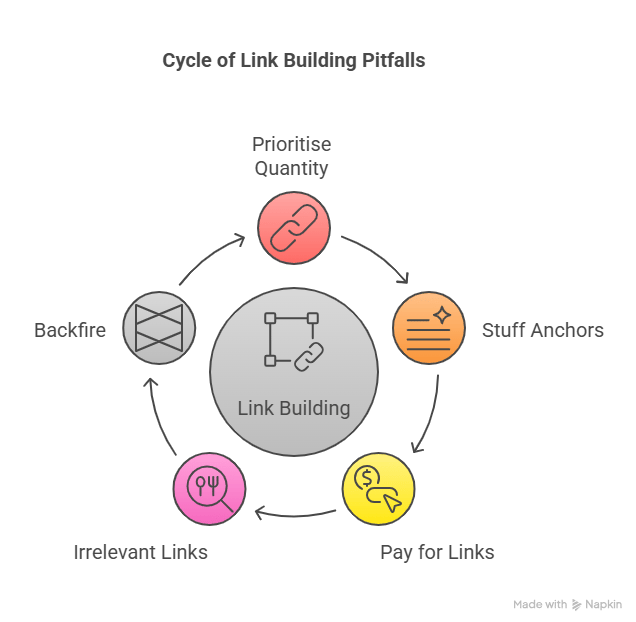
White hat link building means playing by the rules, but there are still mistakes that can hurt you even when your intentions are clean. Avoid link exchanges, link purchasing, and submissions to low-quality directories. These shortcuts may not look like a big deal at first, but they either earn you a penalty or slowly weaken your website's authority.
Also skip links from irrelevant sites. A high domain authority score doesn't make a site the right fit for you. In 2026, relevance matters more than raw metrics.
The strongest argument against doing this the slow way
Most articles on this topic skip the obvious objection, so here it is properly.
In November 2026, an r/SEO poster titled a thread "Black hat gets rewarded?" and described a competitor buying cheap keyword-matched domains, putting a single AI-written blog on each one, and linking back to itself with varied anchors:
"On just one blog host, they have nearly 50 of these mini "sites." They do this with multiple cheap blog hosting sites, resulting in hundreds of backlinks from keyword dense, fake urls... They have low DR. Less reviews (by a lot). For a long time, I could not figure out why they're out ranking everybody." (u/Correct_Score_3330)
The top reply did not reassure him:
"Yes, Black Hat gets rewarded. One look at the serps in different niches reveals the difference between Google guidelines and what actually works." (u/Darth_Vaper883)
Another was blunter about the trade:
"PBNs still work despite what Google will tell you. You can either stick with being white hat and getting beat or go to the dark side" (u/JTSwagMoney)
Take that seriously rather than waving it away. These are people looking at live SERPs in their own niches, and the honest answer is that manipulative link schemes frequently do work, sometimes for years. Any article claiming otherwise is asking you to disbelieve what you can see in front of you.
What the same thread says back
The rebuttal in that thread is not "black hat doesn't work". It is that the tactic and the risk are priced differently depending on what you are building.
"All tactics work (even the ones most redditors swear will get you penalized), the question is usually your timeline, budget, and long term goals. Most SEOs avoid pure black hat tactics bc there's a risk to brand reputation associated with it" (u/big_whale_goes_laps)
One commenter who identified the competitor's setup as a private blog network pointed out that being visible enough to get noticed is itself the problem:
"If you noticed what they are doing then they are likely not covering their footprints very well so it may be a matter of time until Google deindexes them or devalues their links. I wouldn't bank on it being soon" (u/AppointmentTop3948)
And another reported the opposite experience from the most recent algorithm update:
"For now. Let them continue this strategy, dig themselves in a hole, and then wait for the search engines to catch on. I'm seeing a lot of wins from my best practices paying off from this last algo update. Competitors who scaled late last year/early this year in automated ways are losing their momentum and spots." (u/XxBoognishxX)
These are individual reports from individual operators, not measured outcomes, and they should be read that way. Nobody in that thread produced data.
How to actually decide
The useful framing is not ethics but which failure you can survive.
A private blog network is a rented position. It holds while the footprint goes unnoticed and disappears when it does not, and the rankings go with it because nothing else was holding them up. If you are running a churn-and-burn affiliate site, that trade can make sense. The site was disposable anyway.
It is a bad trade for a company with a name to protect. As one commenter in the thread put it, the reason most SEOs avoid it is brand risk, and he had watched companies rebrand after scaled programmatic content caught up with them. A funded SaaS cannot rebrand cheaply. Neither can one whose buyers search for it by name.
The other half is what a link does besides pass authority. A listing on a directory your buyers actually browse sends people, and it keeps sending them whether or not the link is passing anything. A link from a fake site that nobody visits has exactly one function, and it stops working the moment it is devalued. That is the real argument for the slow route, and it does not require believing that Google catches everything.
Why the slow links keep working
The difference is what happens when you stop.
Links earned from real sites stay earned. A resource page that lists you keeps listing you, a directory your buyers browse keeps sending them, and a journalist who quoted you once will often come back. None of that depends on a footprint staying hidden. Turn off the campaign and the links you already have keep doing their job.
That is the whole case, and it is a narrower claim than most articles on this topic make. White hat link building is not faster or guaranteed, and it will not always beat a competitor willing to take risks you are not. What it does is put your rankings on a base that an algorithm update is more likely to reward than remove.
Where to start this week
If you are building the base rather than gaming it, the cheapest first move is the one that takes the least judgement: get listed everywhere your category already gets listed. Directory and launch listings are real sites, with editorial review in the good cases, and they send referral traffic. The cost is time, not risk.
Pick ten directories relevant to what you sell, submit properly, and write down which ones sent a visitor. That list is worth more than any tactic in this post because it is yours and it is measured. If you would rather not spend the weekends on it, our done-for-you directory submission service does the same work by hand.
Sources
- r/SEO, "Black hat gets rewarded?", November 2026. Community testimony from u/Correct_Score_3330, u/Darth_Vaper883, u/JTSwagMoney, u/big_whale_goes_laps, u/AppointmentTop3948 and u/XxBoognishxX, quoted as individual operator experience rather than as measured results.
FAQs
What is white hat link building?
White hat link building is earning backlinks with methods search engines are happy to see: publishing something worth citing, building real relationships, getting listed in the places your category already gets listed, and pitching journalists and resource-page owners on merit. The test: if the link would still make sense to a human editor who knew exactly how you got it, it is white hat.
What is the difference between white hat and black hat link building?
Black hat link building manufactures links from sites that exist only to pass authority, private blog networks, bulk marketplace packages, and keyword-matched domains carrying one AI-written post. White hat earns links from sites that would exist anyway. The practical difference is what you own afterwards. Manufactured links stop working once the footprint is spotted. Earned links keep working, and keep sending referral traffic either way.
Does black hat link building actually still work?
Often, yes, and pretending otherwise is why so much advice on this topic gets ignored. SEOs regularly report competitors ranking well on private blog networks for years, and there is a long r/SEO thread of exactly that complaint. The counter-argument is not that it fails. It is that you are renting the position, with a brand-damage bill attached when it ends. That trade can suit a disposable affiliate site. It rarely suits a company whose buyers search for it by name. There is a full section on this above.
How long does white hat link building take to show results?
Longer than anyone selling it will tell you, and it varies too much by niche and starting authority for a single honest number to exist. Directory and launch listings tend to be the fastest visible step because they are approved in days or weeks rather than earned over months, which is why they are usually the sensible place to start.
Are directory submissions white hat?
The good ones are. A directory that reviews submissions, gets real visitors and lists companies a human curated is an ordinary, legitimate listing. A directory that publishes anything, exists only to sell links and has no readers is not, whatever Domain Rating it carries. Judge the directory by whether the listing would send you a customer, not by its metrics.
Related tools & guides
Want these links without the spreadsheet?
We submit your product to 100+ directories by hand, starting at $99. Or the agent finds and pitches the pages already ranking for your keywords for $99 a month. Either way, you see every link before it goes live.